
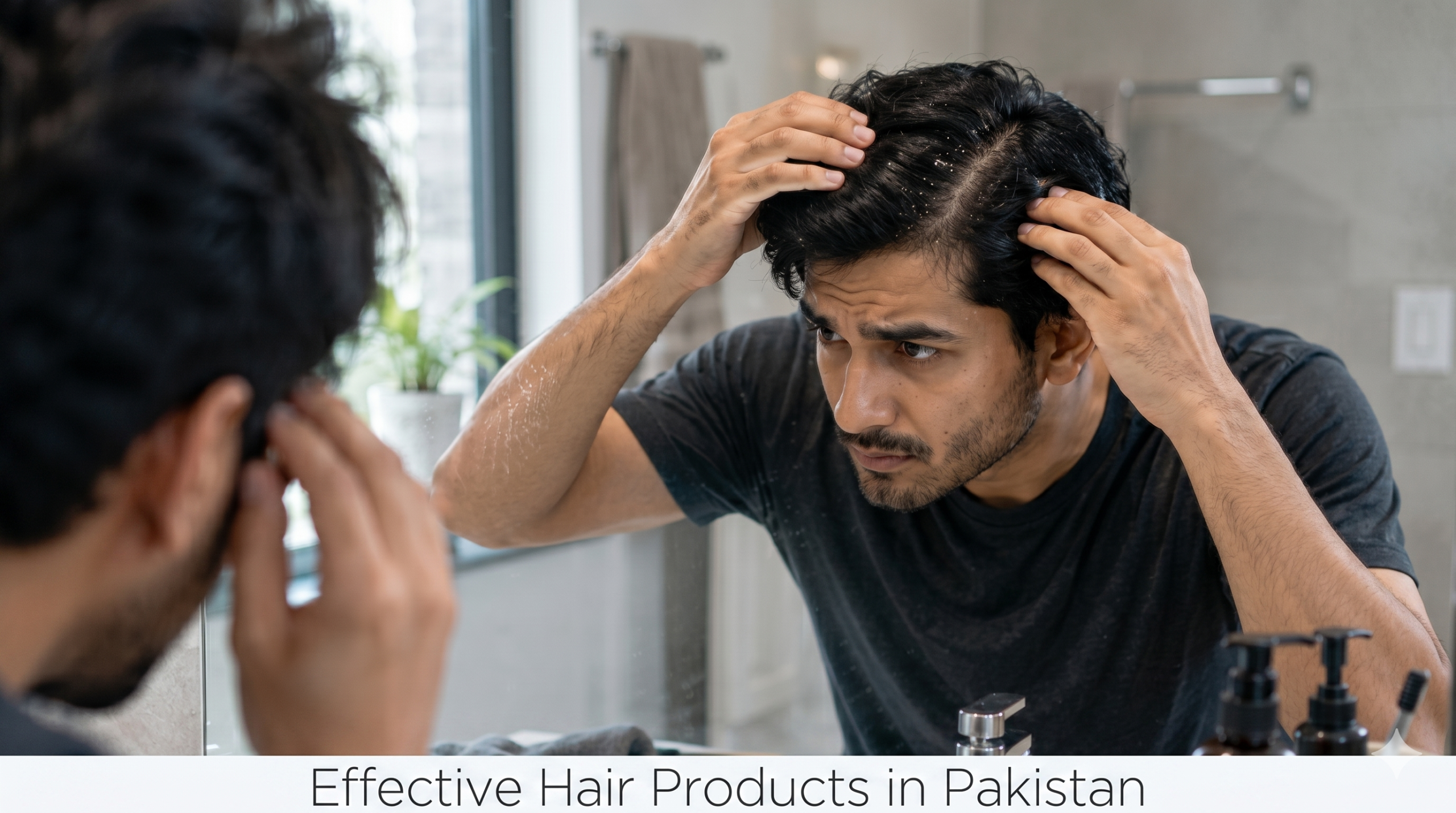
Effective Hair Care Products in Pakistan for Healthy Hair
Pakistan puts hair through conditions that most of the world’s best-selling products were never designed to survive. A UV index that stays above 8 for seven consecutive months. Municipal water carrying calcium and magnesium deposits that coat every strand and clog every follicle with each wash. Humidity between 60% and 90% from May through September across most major cities. Pollution levels in Lahore and Karachi routinely exceed safe limits by several multiples. And underneath all of that, a genetic prevalence of androgenetic alopecia that affects roughly half of Pakistani men by their fifties and a significant proportion of women dealing with postpartum and hormonal triggers.
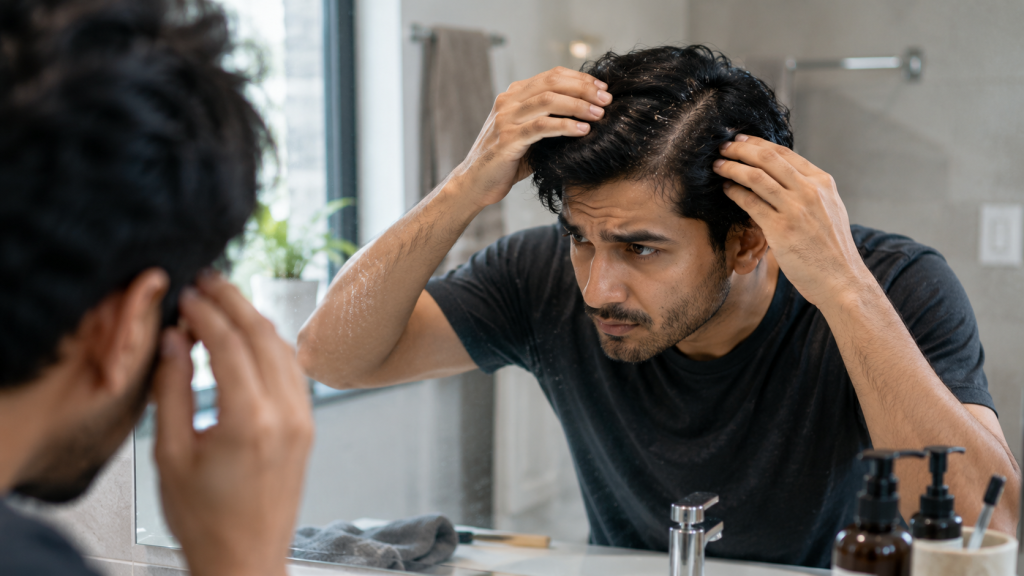
The hair care market has responded, slowly at first and then rapidly over the past three years, with products formulated for these specific conditions. But it has also responded with enormous amounts of noise: oils claiming to reverse baldness, shampoos claiming to be “clinically proven” without any clinical data, and branded actives listed on labels at concentrations so low they produce nothing. Understanding what separates effective hair care from expensive-looking packaging requires going back to basics about what healthy hair and scalp actually need.
What Pakistani Hair Actually Needs
Healthy hair begins at the follicle, and follicle health depends on three things operating correctly at the same time: adequate blood supply delivering oxygen and nutrients, a hormonal environment that does not actively shrink the follicle, and a clean scalp surface that allows any treatment applied actually to penetrate.
Hard water is Pakistan’s most underappreciated hair problem. Every wash deposits a microscopic film of mineral scale on the scalp and hair shaft. Over time, this scale disrupts the scalp’s acid mantle, reduces how much of any topical treatment can absorb, and structurally weakens the hair fibre by competing with the cuticle’s moisture bonds. A medicated serum applied to a mineral-coated scalp does not deliver its full dose to the follicle. The absorption is blocked before the active ingredient ever reaches its target.
This is why the most effective best hair care products in Pakistan are those that address the complete chain of factors: preparing the scalp surface, treating the follicle with verified actives at therapeutic concentrations, and managing the hormonal and environmental factors driving hair loss simultaneously.
The same logic applies to the skin. Pakistan’s combination of extreme UV, high pollution, oily skin driven by heat and humidity, and water quality that disrupts the barrier means that the skin care products in Pakistan that actually work are those formulated with these conditions built into the design, not adapted from European or East Asian markets, where the climate, water, and skin type profile look nothing like ours.
The Scalp Is Skin First
Before any conversation about hair growth serums or loss treatments, the scalp needs to be understood as skin that happens to grow hair, not the other way around. Chronic seborrhoeic dermatitis, which presents as persistent dandruff and scalp flaking, is a fungal condition driven by the yeast Malassezia. It is more prevalent in hot, humid climates. Left untreated, it creates scalp micro-inflammation that independently accelerates follicle miniaturization by upregulating androgen receptor expression, making follicles more sensitive to DHT even without any change in actual DHT levels.
A medicated anti-dandruff treatment that addresses Malassezia overgrowth is, therefore, not just a cosmetic concern. It is a prerequisite for any hair loss treatment to reach its full potential. Products like DandruffX PRO Complex 2.8%, which combines Climbazole and Piroctone Olamine in a leave-on formula alongside D-Panthenol for barrier hydration, address both the fungal cause and the barrier damage simultaneously. This matters because the rinse-off anti-dandruff shampoos that dominate Pakistan’s retail shelves wash away their actives before they can maintain meaningful scalp contact.
The same principle governs cleansing. Hard water minerals and excess sebum accumulate on the scalp between washes. A clarifying hair treatment shampoo, designed to remove mineral deposits without stripping the acid mantle entirely, creates the absorption environment that allows anything applied afterwards to work at full strength. It is the preparatory step that makes every product that follows more effective.
Active Treatments: What the Evidence Supports
Two ingredients have the depth of independent clinical evidence that justifies using the word “proven” without qualification: minoxidil and finasteride. Everything else in the hair loss market either has promising early data, has some mechanism but limited human trials, or has neither.
Minoxidil opens potassium channels in the smooth muscle surrounding scalp blood vessels. The resulting vasodilation increases blood flow, oxygen, and growth factors to the follicle bulb and extends the anagen phase. Finasteride inhibits 5-alpha reductase, the enzyme that converts testosterone to DHT, the hormone that progressively miniaturises genetically sensitive follicles. Together they address the two primary mechanisms of androgenetic alopecia from different angles. A 2024 study conducted at Jinnah Postgraduate Medical Centre in Karachi confirmed that topical finasteride with minoxidil produced superior hair density outcomes compared to minoxidil alone in Pakistani men, providing locally relevant clinical evidence.
The Xtra Hair range delivers these actives at three concentration levels mapped to hair loss stage. Xtra Hair Topical Solution at 5% Minoxidil and 0.1% Finasteride is the appropriate starting point for early thinning. Xtra Hair Pro at 6% Minoxidil and 0.3% Finasteride, with Biotin and Caffeine, is designed for moderate progression. Xtra Hair Pro Marshal at 7% Minoxidil, 0.3% Finasteride, Tretinoin, and Melatonin covers advanced androgenetic alopecia where maximum vasodilation and DHT suppression are clinically indicated. Every bottle is independently lab-tested with HPLC analysis confirming the exact concentrations on the label. The lab report number is published on each product page.
For women, Finasteride is contraindicated in reproductive-age women. Xtra Hair HER uses 4% Minoxidil, Tretinoin for penetration enhancement, Melatonin for hair cycle support through receptor-mediated mechanisms, and Caffeine for anagen phase extension, addressing female pattern hair loss and postpartum shedding without hormonal risk.
Where Botanical Actives Fit in a Complete Routine
High-concentration botanical and peptide serums are not replacements for pharmaceutical treatment in active androgenetic alopecia. They are the layer that covers the biological pathways Minoxidil and Finasteride do not directly address.
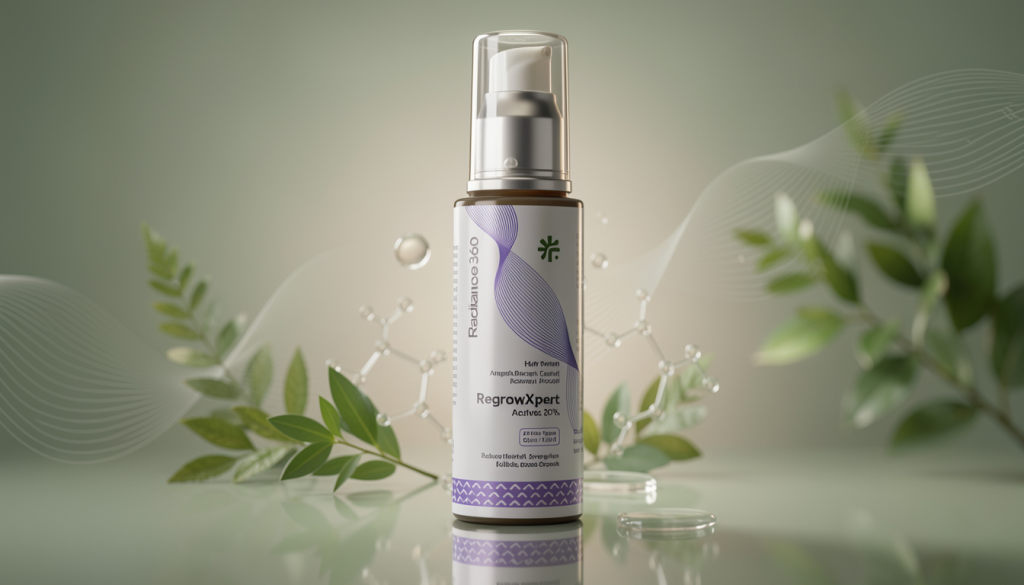
Redensyl activates stem cells in the outer root sheath. Capixyl reinforces follicle anchoring through collagen and laminin proteins while mildly inhibiting 5-alpha reductase. Procapil improves scalp microcirculation through apigenin and partially blocks DHT conversion. Anagain upregulates the growth factors FGF7 and Noggin that govern hair cycle initiation. A product like Regrow Xpert Actives 20%, which combines all five actives at a combined concentration far above the 1% to 5% found in most comparable serums available in Pakistan, addresses follicle stem cell activation, anchoring, and inflammation through mechanisms that pharmaceutical treatment simply does not target. Applied in the morning while pharmaceutical serums are used in the evening, it completes a layered protocol covering six distinct biological mechanisms.
This layered logic is the architecture of effective hair care. Not one product that does everything, but a system where each product covers what the others cannot.
UV Damage: The Hidden Accelerant
Most hair care routines in Pakistan end at oil or serum, with no thought for UV protection of the scalp and hair. This is a significant gap. Pakistan’s UV index exceeds 10 from March through October across most of the country, placing it in the extreme category for the majority of the year.
UV radiation degrades keratin proteins directly. It drives oxidative stress at the follicle that accelerates ageing independently of DHT. It bleaches melanin in the cortex over repeated exposure. And it undermines the effectiveness of any growth treatment by creating a background level of follicle stress that the treatment has to work against. A Frizz Control UV Complex with SPF30 specifically formulated for the hair shaft and scalp provides the environmental protection that prevents this background acceleration of hair damage.
Oils, Supplements, and the Ingredients That Genuinely Do Not Treat Hair Loss
Honesty about what does not work is as important as knowing what does. Hair oils, including coconut oil, castor oil, and amla oil, cannot penetrate the hair cortex in a therapeutically meaningful way and cannot treat androgenetic alopecia. They reduce mechanical friction, moisturise the cuticle, and support a healthy scalp environment. Hair Revive Oil, for example, with Amla, Brahmi, Jatamansi, Rosemary Oil, Castor Oil, and Mustard Oil, has genuine supportive uses alongside pharmaceutical treatment. It does not replace pharmaceutical treatment for active hair loss.
Biotin supplements are the most widely sold hair loss product in Pakistan and among the least justified for the majority of users. Clinical biotin deficiency causing hair loss is rare. Supplementing beyond sufficiency in the absence of a deficiency produces no measurable benefit. The money spent on biotin tablets would produce better outcomes if redirected toward verifying ferritin and thyroid levels, both of which, when deficient, cause chronic hair shedding that responds directly to correction.
Putting It Together
A complete hair care routine for Pakistani conditions looks like this: a mineral-clearing or medicated shampoo to prepare the scalp, a pharmaceutical-grade topical serum with verified concentrations of Minoxidil and Finasteride matched to the stage of hair loss, a peptide and botanical serum applied at a separate time to cover the additional biological mechanisms, scalp UV protection during peak UV months, and a supportive oil for non-treatment days to maintain barrier hydration.
This is not a complex or expensive protocol. It is a system where each product does a specific job that the others cannot do, and where the combination of jobs covers the full set of reasons Pakistani hair loses density faster than it should.
The brands worth trusting in this market are the ones that publish their ingredient concentrations, hold third-party lab verification, and are honest about what each product category can and cannot do. That standard is not common, but it is the only one that produces results you can actually track.


