

Punjab Bans Media Entry in Schools Without Permission 2026
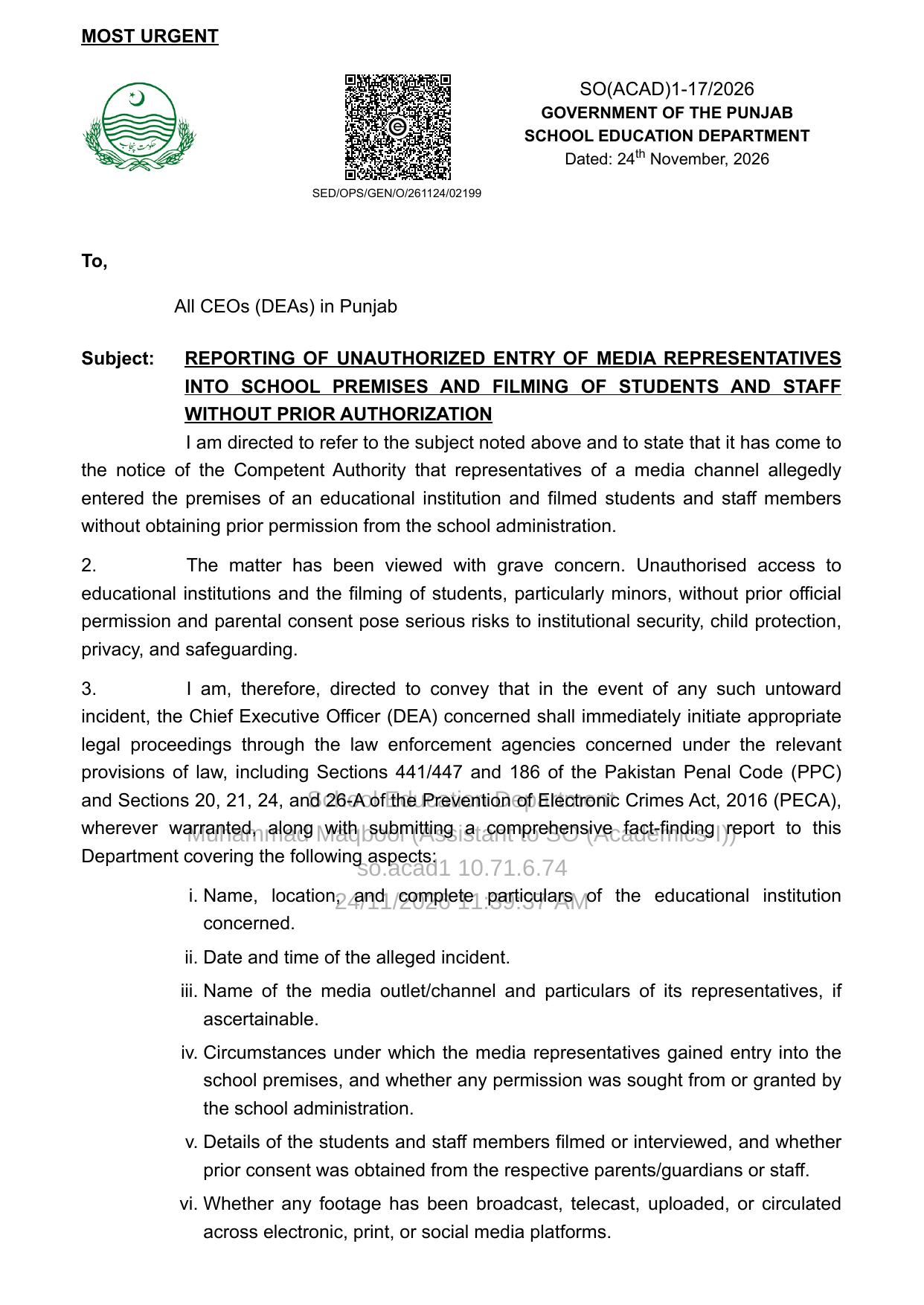
The School Education Department Punjab has directed all District Education Authorities to take strict action against media representatives who enter school premises and film students and staff without permission. The direction came in an official letter dated 24 November 2026, after a media channel’s representatives allegedly entered an educational institution and filmed students and staff without obtaining prior permission from the school administration.
The department has viewed the matter with grave concern. The letter says that unauthorised access to educational institutions and the filming of students, particularly minors, without prior official permission and parental consent pose serious risks to institutional security, child protection, privacy and safeguarding.
This article explains what the letter says, which laws the department has cited, what the District Education Authorities must do now, and what school heads and parents should know. All facts come from the official letter itself. Where the letter does not name a person, a school or a channel, this article does not guess.
Status on 24 November 2026
- Letter: SO(ACAD)1-17/2026, SED/OPS/GEN/O/261124/02199, dated 24 November 2026.
- Issued by: Section Officer (Academics), School Education Department, Government of Punjab.
- Addressed to: All Chief Executive Officers (District Education Authorities) in Punjab.
- Subject: unauthorised entry of media representatives into school premises and filming of students and staff without prior authorisation.
- Laws cited: Sections 441/447 and 186 of the Pakistan Penal Code; Sections 20, 21, 24 and 26-A of the Prevention of Electronic Crimes Act, 2016.
- Disciplinary law cited: Punjab Employees Efficiency, Discipline and Accountability (PEEDA) Act, 2006.
Key Takeaways
- Punjab School Education Department has banned media entry into schools without prior written authorisation.
- Any unauthorised entry and filming of students or staff must be reported, and legal proceedings must be started under the PPC and PECA.
- The CEO (DEA) concerned must send a fact-finding report to the department covering 8 points.
- School heads must not allow any filming inside a school without prior written authorisation from the Competent Authority.
What Happened
According to the letter, it came to the notice of the Competent Authority that representatives of a media channel allegedly entered the premises of an educational institution and filmed students and staff members without obtaining prior permission from the school administration. The letter does not name the media channel, the school, the district or the date of the incident. This article also does not name them, because the letter does not.
The department has viewed the matter with grave concern. The letter says that unauthorised access to educational institutions and the filming of students, particularly minors, without prior official permission and parental consent pose serious risks to institutional security, child protection, privacy and safeguarding. The emphasis on minors is important: children cannot give consent for filming, and their parents or guardians must be asked first.
The letter is marked MOST URGENT. It was issued on 24 November 2026 and sent to all Chief Executive Officers (District Education Authorities) in Punjab. Copies were also sent to all Deputy Commissioners in Punjab, all District Public Instruction officers (Elementary and Secondary Education), and the private secretaries of the School Education Department and the Minister’s office.
What the Department Has Directed
The department has directed that in the event of any such untoward incident, the Chief Executive Officer (DEA) concerned shall immediately initiate appropriate legal proceedings through the law enforcement agencies concerned under the relevant provisions of law. The letter names two laws: Sections 441/447 and 186 of the Pakistan Penal Code (PPC), and Sections 20, 21, 24 and 26-A of the Prevention of Electronic Crimes Act, 2016 (PECA). The proceedings are to be started wherever warranted, which means the DEA must judge each case on its facts.
The PPC sections deal with criminal trespass and obstructing a public servant in the discharge of public functions. The PECA sections deal with offences relating to the dignity of a natural person, cyberstalking, and the publication of false information, among others. The letter does not explain each section in detail. It cites them as the legal provisions under which proceedings can be started.
Along with the legal proceedings, the CEO (DEA) concerned must submit a comprehensive fact-finding report to the department. The report must cover eight aspects, listed in the next section.
The 8 Points of the Fact-Finding Report
- Name, location and complete particulars of the educational institution concerned.
- Date and time of the alleged incident.
- Name of the media outlet or channel and particulars of its representatives, if ascertainable.
- Circumstances under which the media representatives gained entry into the school premises, and whether any permission was sought from or granted by the school administration.
- Details of the students and staff members filmed or interviewed, and whether prior consent was obtained from the respective parents or guardians or staff.
- Whether any footage has been broadcast, telecast, uploaded or circulated across electronic, print or social media platforms.
- Immediate action taken by the school administration and the District Education Authority in response to the incident.
- Security or administrative lapses identified during the preliminary inquiry, along with clear recommendations for fixing responsibility.
Protection of Students and Evidence
The letter also directs the authorities to ensure four things. First, all relevant CCTV footage, visitor registers and other documentary or electronic evidence must be immediately secured and preserved. Second, no subsequent filming, photography or recording is permitted within the premises of any educational institution.
Third, the privacy and identity of students must be strictly protected, and no footage identifying affected children may be shared or circulated on any platform. Fourth, appropriate disciplinary proceedings under the Punjab Employees Efficiency, Discipline and Accountability (PEEDA) Act, 2006 must be started wherever negligence or violation of prescribed security protocols is established.
The third direction matters most for parents. If footage of a child has been filmed without consent, it must not be shared further. The department’s direction is clear: the identity of affected children must be protected, and no footage that identifies them may be circulated.
What School Heads Must Do Now
The letter directs that all Heads of Institutions be sensitised regarding strict visitor management, institutional security protocols, and the mandatory requirement of prior written authorisation from the Competent Authority before granting media access to school premises. Strict compliance with these instructions shall be ensured in letter and spirit.
In plain words, no school head can allow a media team inside a school on a verbal request or on the spot. Media access needs prior written authorisation from the Competent Authority. Visitor registers must be maintained, and any person entering the school must be recorded. If a media team arrives without written authorisation, the school head must not allow entry or filming.
Parents should also know their rights. A school cannot allow filming of a minor child without prior consent from the parents or guardians. If a parent learns that their child was filmed at school without consent, they should inform the school head and the District Education Authority immediately, and ask what action has been taken.
What the Letter Does Not Say
An honest article must also say what is missing. The letter does not name the media channel, the school, the district or the date of the alleged incident. It does not say whether any footage was actually broadcast or circulated. It does not say whether any person has been arrested or charged. None of those details can be reported until the fact-finding report is submitted or the department shares more information.
The letter is a general direction to all District Education Authorities, not a report on one incident alone. Its purpose is to set the rule for every school in Punjab: no media entry and no filming without prior written authorisation, and strict action if it happens. This article will be updated when the department shares the findings of any fact-finding report.
FAQs
What has the Punjab School Education Department directed about media in schools?
The department has directed that no media representative may enter a school or film students and staff without prior written authorisation from the Competent Authority. If it happens, the District Education Authority must start legal proceedings and send a fact-finding report to the department. The direction was issued in a letter dated 24 November 2026.
Which laws has the department cited for action against unauthorised media entry?
The letter cites Sections 441/447 and 186 of the Pakistan Penal Code and Sections 20, 21, 24 and 26-A of the Prevention of Electronic Crimes Act, 2016. It also directs disciplinary proceedings under the Punjab Employees Efficiency, Discipline and Accountability (PEEDA) Act, 2006 where negligence or violation of security protocols is established.
What must a District Education Authority do after such an incident?
The CEO (DEA) must immediately start legal proceedings through the law enforcement agencies and submit a comprehensive fact-finding report to the department. The report must cover the school, the date and time, the media outlet, how entry was gained, who was filmed, whether consent was taken, whether footage was circulated, and what action was taken.
Can a school head allow a media team to film inside the school?
No. A school head can allow media access only with prior written authorisation from the Competent Authority. A verbal request or an on-the-spot permission is not enough. The letter directs all heads to be sensitised about strict visitor management and security protocols, and says strict compliance shall be ensured in letter and spirit.
What should parents do if their child was filmed at school without consent?
Parents should inform the school head and the District Education Authority immediately and ask what action has been taken. The letter directs that the privacy and identity of students be strictly protected and that no footage identifying affected children be shared or circulated on any platform. Consent of parents or guardians is required before filming a minor.
Sources
- Government of Punjab, School Education Department, letter No. SO(ACAD)1-17/2026, SED/OPS/GEN/O/261124/02199, dated 24 November 2026: “Reporting of Unauthorized Entry of Media Representatives into School Premises and Filming of Students and Staff Without Prior Authorization”.


